



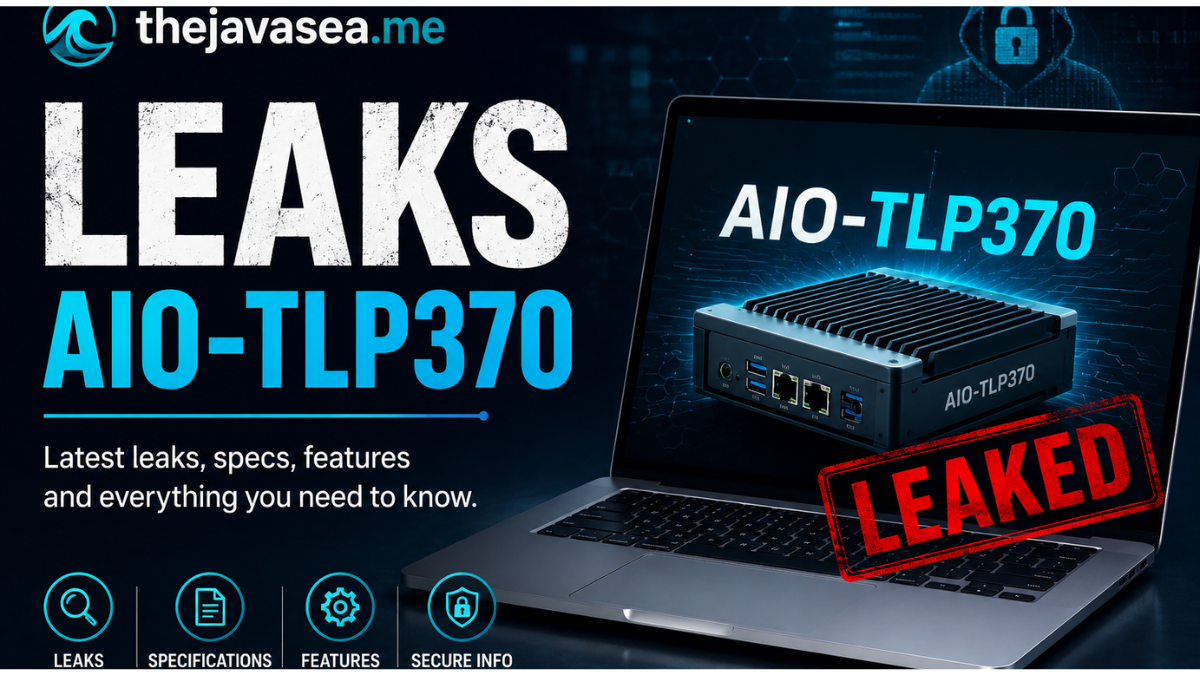
A comprehensive cybersecurity guide on the thejavasea.me leaks and AIO-TLP370 archive. Discover threat actor tactics, credential stuffing risks, malware vectors, and enterprise breach response strategies.
The proliferation of online leak repositories, database forums, and underground distribution hubs has fundamentally altered the threat landscape for both enterprise defense teams and individual web users. Aggregated data archives—frequently distributed through illicit portals such as thejavasea.me—contain millions of compromised credentials, personal identification records, session tokens, and system logs compiled from multi-year cyber incidents.
Among these distributions, specialized bundles labeled under terms like AIO-TLP370 represent “All-In-One” (AIO) compiled threat packages. Understanding the structure, exposure risks, and distribution channels of these leaks is vital. Organizations must understand how malicious actors process and weaponize aggregated data to execute account takeover (ATO) attacks, financial fraud, and supply-chain compromises.
1. Decoding thejavasea.me and the AIO-TLP370 Leak Archive
Data distribution platforms operate as central clearinghouses for stolen digital assets. The domain thejavasea.me emerged within cybercrime and credential-sharing communities as an index for aggregated database dumps, infostealer logs, and software exploitation scripts.
What Is an “AIO” (All-In-One) Leak Bundle?
An “All-In-One” (AIO) bundle refers to a consolidated archive containing disparate data sets merged into a single searchable file or folder structure. Rather than containing data from a single security incident, an AIO leak combines:
- Combo Lists: Structured text files formatted as
email:passwordorusername:passwordpaired across thousands of breached domains. - Infostealer Malware Logs: Full system extractions harvested from Trojanized software (e.g., RedLine, Vidar, Raccoon Stealer) including browser cookies, auto-fill data, crypto wallet extensions, and system metadata.
- Database SQL Dumps: Full or partial relational database exports originating from misconfigured cloud buckets, unpatched Web Applications, or SQL Injection (SQLi) exploits.
- API Key Dumps: Hardcoded secrets, AWS access keys, and bearer tokens extracted from public code repositories or decompiled mobile applications.
Understanding the TLP370 Identifier
In threat intelligence parlance, “TLP” usually stands for the Traffic Light Protocol, a standardized framework created by the Forum of Incident Response and Security Teams (FIRST) to govern information sharing. However, underground communities frequently co-opt technical jargon to create indexing codes.
The designation TLP370 or aio-tlp370 functions as an internal cataloging tag or batch release identifier within specific leak archives. It signals a specific collection volume compiled by threat actors, blending credential harvests with specific automated cracking configurations.
2. Threat Actor Tactics & All-In-One (AIO) Data Harvesting
The creation of massive leak archives like AIO-TLP370 relies on continuous automated data collection methodologies. Threat actors employ multi-tiered collection strategies to maximize the value of stolen information before releasing aggregated versions to broader forums.
       [ Initial Compromise Vectors ]
    /                 |                 \
Infostealer Logs   Database Exploits   API Secret Leakage
    \                 |                 /
     ---> [ Parsing & Aggregation Engine ] <---
                      |
        [ AIO-TLP370 Bundled Archive ]
                      |
      ---> [ Weaponization & Exploitation ]
            (Credential Stuffing / ATO)
Infostealer Deployments
Modern breach archives are heavily populated by infostealer logs. Cybercriminals distribute malvertising campaigns, cracked software installers, and phishing attachments that execute stealthy background stealers. These utilities capture session states directly from local storage, bypassing standard password hashing protections.
Automated Cloud & Database Scraping
Threat actors deploy specialized scanners to identify publicly exposed ElasticSearch, MongoDB, and AWS S3 instances. When unsecured databases are discovered, automated scripts extract the entire schema within minutes.
De-duplication and Normalization
Raw stolen data is chaotic and filled with junk records. To produce high-value AIO packages, threat actors run automated normalization scripts that:
- Parse unformatted text into clean
email:passwordpairs. - Remove duplicate records across legacy dumps.
- Classify data by geographic location, domain extension (e.g.,
.gov,.edu,.com), or specific industry targets.
3. Credential Stuffing & Account Takeover (ATO) Dynamics
The primary commercial application for leak bundles like AIO-TLP370 in underground markets is credential stuffing. Credential stuffing exploits human behavior—specifically, the widespread practice of reusing identical passwords across multiple personal and professional services.
                 +-----------------------+
                 | AIO-TLP370 Combo List |
                 +-----------+-----------+
                             |
                             v
                 +-----------------------+
                 |  Proxy Rotation Pool  |
                 +-----------+-----------+
                             |
                             v
                 +-----------------------+
                 | Automated ATO Engine  |
                 | (OpenBullet / Custom) |
                 +-----------+-----------+
                             |
     +-----------------------+-----------------------+
     |                                               |
     v                                               v
[ Target 1: Banking Portal ]          [ Target 2: Corporate SSO ]
 - 200 OK -> Valid Account             - 200 OK -> Valid Account
 - Captures Balance & Session          - Triggers Phishing Push
The Mechanics of Automated Credential Stuffing
Threat actors load AIO combo lists into specialized automated testing frameworks (such as OpenBullet, SilverBullet, or custom Python scripts). The attack process follows a precise sequence:
- Target Selection: Actors write or purchase custom “configs” designed to parse authentication endpoints for specific high-value services (e.g., streaming sites, banking portals, retail sites, or enterprise VPNs).
- Proxy Rotation: Attacks utilize residential proxy pools to distribute requests across tens of thousands of unique IP addresses, invalidating traditional IP-rate-limiting rules.
- Response Parsing: The tool reads HTTP response codes, headers, and payload bodies to separate invalid logins from successful hits (“valids”).
- Account Harvesting: Successful hits are captured, along with account specifics like stored payment methods, reward points, or linked privileges.
4. Analyzing TLP Classification: Enterprise Standard vs. Underground Usage
To understand how information handling differs between legitimate security operations and underground breach forums, it is useful to contrast official Traffic Light Protocol standards with leak forum classifications like aio-tlp370.
| Parameter | Official FIRST TLP Standard | Underground Leak Forum Usage (e.g., TLP370) |
| Primary Purpose | Standardizes boundaries for sensitive security information sharing. | Used as internal batch release tracking, batch versioning, or cataloging. |
| Access Control | Enforced by trust circles (TLP:RED, TLP:AMBER, TLP:GREEN, TLP:CLEAR). | Gated by forum tier status, paywalls, or crypto-based purchase requirements. |
| Data Integrity | Cryptographically verified and shared via vetted CTI channels. | Raw, aggregated, unverified compilation of multiple breaches and infostealer logs. |
| Risk Profile | Designed to prevent unauthorized disclosure of active vulnerabilities. | High risk of active exploitation, malware infection, and privacy violations. |
| Legal Status | Authorized threat-intelligence sharing mechanism. | Unauthorized distribution of stolen PII and proprietary data. |
5. Legal, Regulatory, and Compliance Fallout of Exposed Data
When enterprise credentials or customer records appear in public leak repositories like thejavasea.me, affected organizations face immediate legal and regulatory exposure.
Regulatory Framework Mandates
General Data Protection Regulation (GDPR)
Under Article 33 of the GDPR, organizations discovering a breach involving personal data must notify the relevant supervisory authority within 72 hours. Failure to secure user credentials or report breach incidents can result in penalties up to €20 million or 4% of global annual turnover.
California Consumer Privacy Act (CCPA / CPRA)
The CPRA provides consumers with a private right of action if their non-encrypted or non-redacted personal information is breached due to a failure to maintain reasonable security procedures.
Health Insurance Portability and Accountability Act (HIPAA)
If an AIO leak bundle exposes Protected Health Information (PHI) or system credentials accessing medical databases, entities face strict Breach Notification Rule enforcement and severe civil monetary penalties.
6. Malware Distribution & Phishing Vectors Embedded in Leak Packs
Downloading or interacting with leak packs from unauthorized distribution forums carries significant technical risk. Archives labeled as data leaks are frequently used as delivery mechanisms for malicious software.
+-------------------------------------------------------------+
|               Downloaded Archive: AIO-TLP370.zip            |
+------------------------------+------------------------------+
                               |
       +-----------------------+-----------------------+
       |                                               |
       v                                               v
[ Valid Text Files ]                        [ Executable / Payload ]
 - combo_list.txt                            - Viewer_Installer.exe
 - leaked_users.csv                          - Scraper_Tool.exe
                                                       |
                                                       v
                                            [ Silent Dropper Execution ]
                                                       |
                                            [ System Compromise / C2 Connection ]
Trojanized Archive Tools
Archives hosted on third-party file locker sites linked by leak sites often require specific extractors, viewers, or “checker tools” to read the dataset. Threat actors bind remote access trojans (RATs), keyloggers, or stealer executables directly to these utility downloads.
Second-Order Phishing Campaigns
Data exposed in AIO leaks provides threat actors with rich context for social engineering attacks:
- Targeted Executive Phishing: Exposing work emails combined with legacy passwords enables convincing pretexting messages (e.g., “Your legacy account password
P@ssword123was compromised; click here to reset”). - SMS Smishing & Call Spoofing: When leak sets include phone numbers linked to usernames, attackers initiate multi-channel MFA fatigue attacks.
7. Impact on Individual Privacy & Digital Identity Exposure
For individuals, finding personal details within an AIO leak archive compromises their entire digital identity footprint.
The Cascade Effect of Credential Reuse
When a user reuses a single password across multiple accounts (e.g., a personal email, a banking application, and an online store), a leak in a low-security platform exposes all linked accounts.
Doxxing and Extortion Schemes
Aggregated archives allow threat actors to cross-reference data points. An actor can query a single email address to aggregate physical addresses, phone numbers, past passwords, and financial footprints, facilitating targeted harassment, identity theft, or extortion attempts.
8. Enterprise Defense: Breach Monitoring & Threat Intelligence Integration
Organizations must shift from passive security postures to proactive threat intelligence monitoring to detect and neutralize credential exposure before weaponization occurs.
[ Dark Web / Leak Monitoring ] ---> [ Automated Parsing Engine ]
                                                |
                                                v
[ Security Operations Center ] <--- [ Hash Matching & Alerting ]
             |
             v
[ Automated Playbook Execution ] -> (Force Password Reset / Revoke Sessions)
Implementing Breach Intelligence Feeds
Enterprise SOC (Security Operations Center) teams should integrate automated Cyber Threat Intelligence (CTI) feeds that continuously index underground forums, code repositories, and paste sites.
Key Metrics for Evaluating Breach Intelligence Data
- Ingestion Speed: The time elapsed between a leak appearing on a distribution forum and its ingestion into internal monitoring systems.
- Accuracy & Deduplication Rate: Filtering out legacy, recycled data dumps to focus analyst resources on newly exposed credentials.
- Match Precision: Matching exposed credentials against active enterprise Active Directory or Okta identity stores.
9. Practical Incident Response Framework for Exposed Credentials
When threat intelligence tools confirm that enterprise domain credentials appear in an AIO leak set, security teams must execute a structured incident response playbook.
[ Discovery Phase ] ──> Identify domain hits in leak archive
                            │
                            ▼
[ Containment Phase ] ─> Revoke active tokens & initiate forced password reset
                            │
                            ▼
[ Remediation Phase ] ─> Enforce phishing-resistant MFA (FIDO2)
                            │
                            ▼
[ Forensic Phase ] ────> Audit access logs for anomalous endpoint logins
Step 1: Immediate Account Isolation & Containment
- Revoke Active Sessions: Invalidate all active OAuth tokens, Web sessions, and VPN connections associated with the compromised user account.
- Enforce Force Reset: Flag the account in Active Directory or Azure AD/Entra ID to force a password change upon the next login attempt.
- Quarantine Suspected Host: If the leak originated from an infostealer infection on an enterprise endpoint, isolate the device from the corporate network immediately.
Step 2: Access Log Audit
Examine Identity and Access Management (IAM), VPN, and Cloud SSO authentication logs going back at least 90 days from the estimated breach date. Search specifically for:
- Logins originating from unfamiliar residential proxies or anonymized VPN ranges.
- Impossible travel anomalies (e.g., a login from Chicago followed 10 minutes later by a login from Frankfurt).
- Spikes in failed MFA prompts indicative of MFA fatigue/push spamming attacks.
Step 3: Hardening Multi-Factor Authentication
Replace weak authentication mechanisms (SMS OTPs, email verification codes, and standard push notifications) with phishing-resistant MFA, such as hardware security keys (FIDO2 / WebAuthn) or certificate-based authentication.
10. Technical Examples & Security Implementations
Below are practical, actionable tools and scripts designed to help security teams detect credential leaks and hunt for credential-stuffing behavior within their environments.
Example 1: Python Automation for HIBP Enterprise API Lookup
This script queries the Have I Been Pwned (HIBP) API to check if corporate email addresses appear in known public breach aggregates.
Python
import requests
import time
import json

# Configuration
API_KEY = "YOUR_HIBP_API_KEY"
DOMAIN = "yourcompany.com"
HEADERS = {
    "hibp-api-key": API_KEY,
    "user-agent": "Enterprise-Breach-Checker"
}

def check_domain_breaches(domain):
    url = f"https://haveibeenpwned.com/api/v3/breacheddomain/{domain}"
    response = requests.get(url, headers=HEADERS)

    if response.status_code == 200:
        breached_accounts = response.json()
        print(f"[+] Found {len(breached_accounts)} compromised accounts for domain: {domain}")
        return breached_accounts
    elif response.status_code == 404:
        print(f"[-] No breach data found for domain: {domain}")
        return None
    elif response.status_code == 429:
        print("[!] Rate limit exceeded. Waiting before retry...")
        time.sleep(2)
        return check_domain_breaches(domain)
    else:
        print(f"[!] Error querying API: {response.status_code}")
        return None

if __name__ == "__main__":
    results = check_domain_breaches(DOMAIN)
    if results:
        with open("domain_breach_report.json", "w") as f:
            json.dump(results, f, indent=4)
        print("[+] Report saved to domain_breach_report.json")
Example 2: Sigma Rule for Detecting Credential Stuffing Patterns
This Sigma rule flags high-volume authentication failures originating from a single IP address—a primary signature of automated credential stuffing using leak combo lists.
YAML
title: High Volume Authentication Failures - Potential Credential Stuffing
id: 9a7b4c21-3d2e-4f10-b5a8-98f7e6d5c4b3
status: experimental
description: Detects an unusually high rate of failed login attempts from a single source IP targeting multiple user accounts within a short window.
author: Security Operations Center
logsource:
  category: authentication
  product: web_application
detection:
  selection:
    event_type: 'login_failure'
  timeframe: 5m
  condition: selection | count(user_name) by src_ip > 20
falsepositives:
  - Misconfigured corporate NAT gateways or proxies
  - Enterprise load testing exercises
level: high
tags:
  - attack.credential_access
  - attack.t1110.004
Example 3: Enterprise Password Policy and Identity Checklist
Use the following checklist to evaluate identity security posture against leak-driven attacks:
- [ ] NIST SP 800-63B Compliance: Ban known compromised passwords (compare user password choices against known leak databases like HIBP/AIO packs).
- [ ] Phishing-Resistant MFA: Deploy FIDO2/WebAuthn hardware keys for all privileged administrative accounts.
- [ ] Adaptive / Risk-Based Authentication: Configure SSO policies to require stepped-up authentication when logins originate from new locations or risky IP ranges.
- [ ] Automated Passwordless Transition: Plan migration towards passkeys and certificate-based login models to eliminate password dependencies entirely.
- [ ] Continuous Dark Web Monitoring: Integrate CTI platforms to alert security teams immediately when corporate domain credentials surface in public or darknet repositories.
Addressing the threats posed by data leak repositories like thejavasea.me and consolidated archives like AIO-TLP370 requires moving beyond legacy password management. As threat actors continue automating the collection, normalization, and weaponization of stolen credentials, defense strategies must evolve in parallel.
By deploying phishing-resistant multi-factor authentication, enforcing continuous identity monitoring, leveraging threat intelligence feeds, and implementing automated incident response playbooks, organizations can effectively neutralize the risks of credential exposure and maintain robust defense against identity-based attacks.




One response to “thejavasea.me Leaks & AIO-TLP370: Cyber Threat Analysis”
[…] “All-In-One” (AIO) leak bundle typically arrives compressed in .zip, .rar, or .7z formats to reduce […]